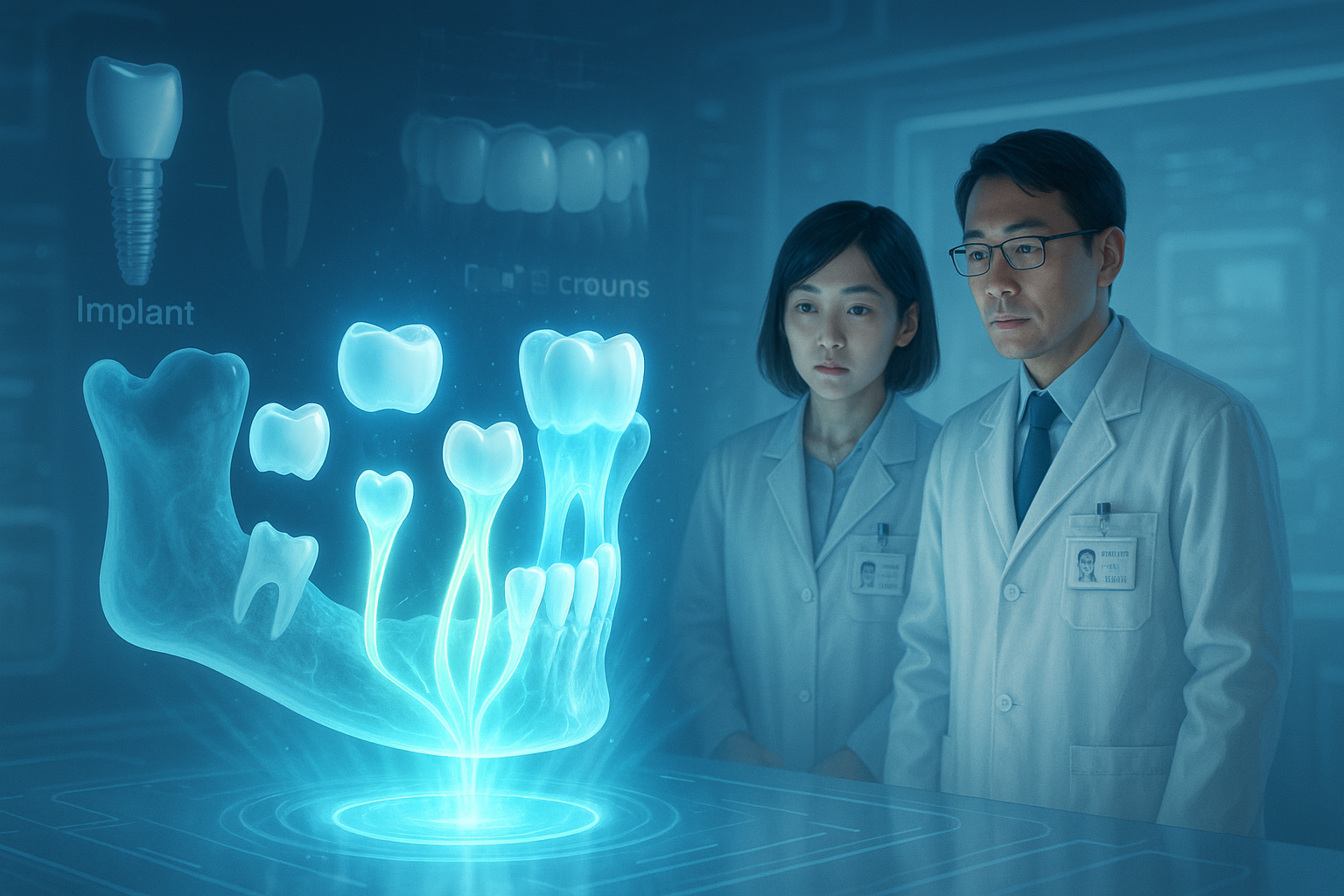

Growing New Teeth: The Scientific Breakthrough in Japan That Will Change Dentistry
Introduction: Beyond Implantation
21st-century dentistry has reached incredible heights in replacing lost teeth. Titanium implants, zirconia crowns, and digital smile design allow for the restoration of chewing function and aesthetics with the highest precision. However, all these methods are based on a single principle: replacing a lost organ with an artificial prosthesis. But what if we could compel the body to regenerate what was lost? This concept, long confined to science fiction, is now becoming a reality thanks to the groundbreaking work of Japanese scientists.
A team of researchers from Kyoto University and the University of Fukui, led by Dr. Katsu Takahashi, head of the Department of Oral and Maxillofacial Surgery, is on the verge of a global sensation. They have developed the world's first drug capable of "awakening" dormant tooth buds and initiating the growth of new, fully-formed teeth. This discovery doesn't just offer an alternative to implants—it promises to change the very paradigm of treating edentulism (toothlessness) and opens a new chapter in regenerative medicine.
The Scientific Basis: How to "Switch Off" the Gene That Blocks Tooth Growth
Underpinning the technology is more than a decade of studying the complex biochemical processes that govern organ development. Humans, like many mammals, have three generations of tooth germs. The first forms deciduous (baby) teeth, the second forms permanent teeth. The third generation remains in a "dormant" state and eventually atrophies. The key question for scientists was: what prevents these germs from developing?
The USAG-1 Gene: A Molecular "Brake"
Through years of research, Takahashi's team identified the key culprit: the USAG-1 (Uterine Sensitization Associated Gene-1) gene. It was discovered that the protein encoded by this gene acts as a powerful inhibitor in the signaling pathways responsible for tooth development.
It simultaneously affects two critical signaling cascades:
BMP (Bone Morphogenetic Protein): This is a key factor that stimulates cell differentiation and the formation of bone and dental tissue.
Wnt (Wingless/Integrated): This signaling pathway plays a critical role in the development of embryonic tissues, including the formation of organs like teeth.
The USAG-1 protein, by binding to components of these pathways, effectively "silences" them, preventing the tooth germ from receiving the command to grow. This is a natural mechanism that prevents hyperdontia—an excess number of teeth. But in patients with edentulism, this "brake" works too strongly or blocks the development of a normal set of teeth.
The Antidote Drug: Pinpoint Neutralization
The solution proposed by the Japanese scientists is elegant in its logic. If there is a protein that blocks everything, a molecule must be created to block the protein itself. This solution came in the form of a monoclonal antibody drug.
Monoclonal antibodies are highly specific proteins created in a laboratory to recognize and bind to one particular target (an antigen). In this case, the antibody was designed to perfectly "fit" the USAG-1 protein, like a key to a lock. By binding to it, the antibody neutralizes it, preventing it from interacting with the BMP and Wnt signaling pathways. As a result, the "brake" is disengaged, and the tooth germ receives the long-awaited signal to develop.
Studies on mice with congenital anodontia showed phenomenal results. After a single injection of the drug, the rodents began to develop fully functional teeth, indistinguishable from normal ones.
From the Lab to the Patient: The Clinical Trial Roadmap
The success in animal models has allowed the biotech startup Toregem Biopharma, created to commercialize the discovery, to plan the transition to human trials. The research schedule is planned for several years ahead.
Phase I (starting September 2024): The first and most crucial stage for safety verification. The study, to be held at Kyoto University Hospital, will involve 30 healthy adult men. The goal is to ensure the drug does not cause side effects and is well-tolerated. Efficacy is not assessed at this stage.
Phase II (planned from 2025): The key stage for evaluating efficacy. It will involve children aged 2 to 7 with congenital anodontia, a genetic condition where six or more teeth are missing. The choice of this group is deliberate: their bodies are in an active growth phase, and their tooth loss is not due to external factors. Doctors will monitor whether the drug initiates tooth growth and how they develop.
Phase III and Market Launch (projected around 2030): If Phase II shows convincing results, a larger-scale study will follow to confirm efficacy and safety in a large patient sample. After that, Toregem Biopharma can apply for drug registration.
Initially, the drug will be positioned as a treatment for congenital anodontia. However, the next target will be adult patients who have lost teeth due to decay, periodontitis, or trauma. According to Dr. Takahashi, the technology could theoretically be applied to anyone who has retained dormant tooth buds.
Advantages of Regeneration Over Implantation: A Technology Comparison
Parameter | Titanium Implant | Regenerated (Natural) Tooth |
|---|---|---|
Nature | Artificial prosthesis, foreign body | Living, natural organ |
Attachment | Osseointegration (fusion with bone) | Periodontal ligament (micro-ligaments that absorb pressure) |
Sensation | No proprioception (sensation of pressure) | Full sensation of pressure when chewing |
Bone Health | Surrounding bone may atrophy | Stimulates and preserves surrounding bone tissue |
Durability | 15-25 years, risk of peri-implantitis | Potentially lifelong, susceptible to normal diseases (e.g., cavities) |
Process | Surgical operation, abutment and crown placement | Potentially one or more injections |